Introduction to AC
The supply of current for electrical devices may come from a direct current source (DC), or an alternating current source (AC).
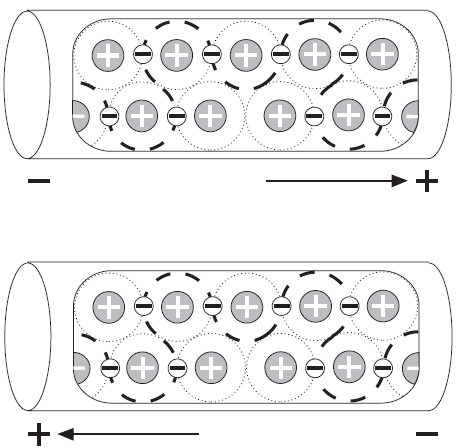
In direct current electricity, electrons flow continuously in one direction from the source of power through a conductor to a load and back to the source of power. The voltage in direct current remains constant. DC power sources include batteries and DC generators. In alternating current an AC generator is used to make electrons flow first in one direction then in another. Another name for an AC generator is an alternator. The AC generator reverses terminal polarity many times a second. Electrons will flow through a conductor from the negative terminal to the positive terminal, first in one direction then another.
AC sine wave
Alternating voltage and current vary continuously. The graphic representation for AC is a sine wave. A sine wave can represent current or voltage. There are two axes. The vertical axis represents the direction and magnitude of current or voltage. The horizontal axis represents time. 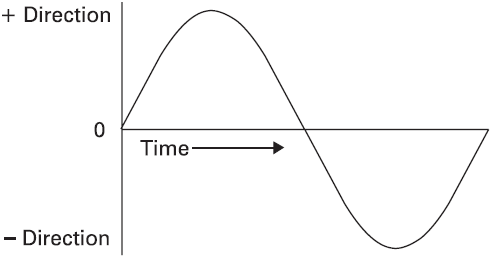 When the waveform is above the time axis, current is flowing in one direction. This is referred to as the positive direction. When the waveform is below the time axis, current is flowing in the opposite direction. This is referred to as the negative direction. A sine wave moves through a complete rotation of 360 degrees, which is referred to as one cycle. Alternating current goes through many of these cycles each second. The unit of measurement of cycles per second is hertz. In the United States alternating current is usually generated at 60 hertz.
Single-phase and three-phase AC power
Alternating current is divided into single-phase and three-phase types. Single-phase power is used for small electrical demands such as found in the home. 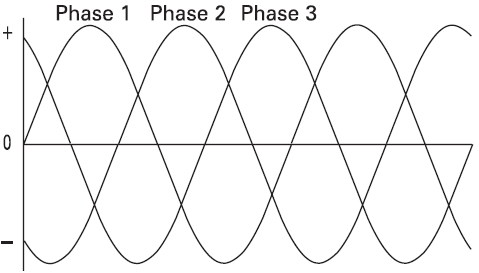 Three-phase power is used where large blocks of power are required, such as found in commercial applications and industrial plants. Single-phase power is shown in the above illustration. Three-phase power, as shown in the following illustration, is a continuous series of three overlapping AC cycles. Each wave represents a phase, and is offset by 120 electrical degrees.
Basic generator
A basic generator consists of a magnetic field, an armature, slip-rings , brushes and a resistive load. 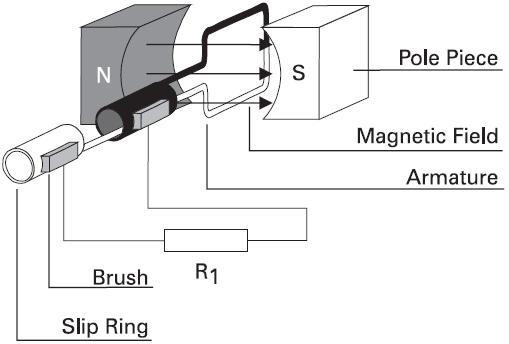 The magnetic field is usually an electromagnet. An armature is any number of conductive wires wound in loops which rotates through the magnetic field. For simplicity, one loop is shown. When a conductor is moved through a magnetic field, a voltage is induced in the conductor. As the armature rotates through the magnetic field, a voltage is generated in the armature which causes current to flow. Slip rings are attached to the armature and rotate with it. Carbon brushes ride against the slip rings to conduct current from the armature to a resistive load.
Que_Ans:
[1] What is a phase?
Phase in a.c system is the fraction of time period which has elapsed since current/voltage last passed through zero position of reference. The unit is in seconds or radians.
[2] What is the unity power factor?
The voltage and current developed in an ac circuit reach their peak values at the same time.